Posts

Showing posts with the label REIT

New Fund: AmAsia Pacific REITs Plus
Image
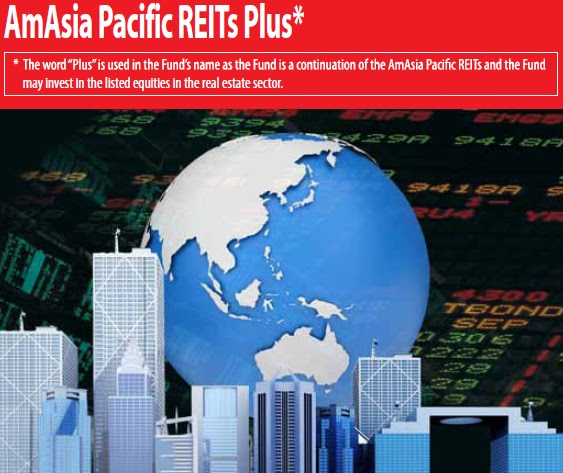
Do you remember the AmAsia Pacific REITs fund? I'm sure you have heard about it. Yes, backed by its success story, AmInvestment Management Bhd has launched a new version called AmAsia Pacific REITs Plus . The word " Plus " is used as a continuation of the AmAsia Pacific REITs and the fund may invest in listed equities in the real estate sector. The fund aims to provide regular income and to a lesser extent capital appreciation over the medium to long term (at least 3 years) by investing in real estate investment trusts (REITs) and equities in the real estate sector. What's the strategy? Minimum 70% in REITs and a maximum of 29% in listed equities in real estate sector, which are in the Asia Pacific region. This is the asset allocation of the fund. Diversification in terms of country and different REITs sub-sectors (etc. residential, commercial and industrial) is expected. An active allocation strategy will be employed by fund manager, based on macroeconomic trends a...

New Fund: OSK-UOB Multi Asset Regular Income Fund

Image
As investor continue to seek safe investment havens, i.e. investments that are more stable and/or of lower risk and with regular income, OSK-UOB Investment Management see opportunities in the Asia and Asia Pacific (ex Japan) region. Hence, they are now offering investors a fund that utilizes a multi-asset strategy to generate potential regular income and capital growth in a fund that invests in three yielding assets i.e. bonds, equities and REITs (real estate investment trusts) from the Asia and Asia Pacific (ex Japan) region. The Fund is suitable for investors who: seek regular income and capital growth over medium to long term; are willing to accept moderate risk in their investments; and wish to benefit from investment exposure in the Asian and Asia Pacific (ex Japan) region. Tactical Asset Allocation? Of the fund's investments, the External Investment Manager will initially invest in accordance to the allocation stated in the table below. However, for the purpose of tactical...

New IPO: IGB Reit

Image
IGB REIT comprises of Mid Valley Megamall (retail; 1.72m sf NLA) and the Gardens Mall (retail; 0.82sf NLA) with a total appraised value of RM4.6b . Currently, Mid Valley Megamall is 99.8% occupied and the Gardens Mall is 99.7% occupied. Based on the IPO  price of RM1.25, IGB REIT’s market capitalization would be RM4.3bn, making  it the largest pure retail M-REIT .  Following closely behind IGB REIT in terms of market capitalization size is Pavilion REIT (RM4.08b), Sunway  REIT (RM4.02b) and CMMT (RM3.02b). What are the key selling points for IGB REIT? Prime asset with strategic location, huge catchment area and well connected  transportation networks. Diverse based of tenants to sustain rental income. Low gearing provides ample room for acquisition growth.   Based on IGB REIT’s Pro Forma Statement of Financial position, IGB REIT’s  gearing ratio upon listing will be approximately 25.8% , which is below the  average o...

New IPO: Pavilion REIT

Image
Are you bored of the current small market capitalization of REITs in Malaysia? I think Sunway REIT (the largest REIT right now) is by far sitting there very lonely without anyone closer to it. Come 7th December 2011 , we will witnessed a new contender - Pavilion REIT , to challenge the title. Although it may started-off in 2nd place, the new REIT may grows to clinch the first place from SunREIT. Below is some info taken from RHB Research report on the IPO; Pavilion REIT (PavREIT) has an asset size of RM3.5bn , just after the largest MREIT - Sunway REIT’s RM4.5bn. PavREIT has two assets – Pavilion KL Mall which is worth RM3.4bn and Pavilion Tower (office) RM128m. The Prime Asset Pavilion Mall is one of the only four premium retail malls in KL. It is designed to complement the malls along Jalan Bukit Bintang, developing the street to a key shopping destination in the region. Located at the “Golden Triangle”, which is the business, shopping, entertainment and...

New Fund: AmAsia Pacific REITs

Image
Despite the current high level of share market globally, especially in Asia, there is still hanging fruits waiting for investor to grab. One of it was REITs, which lags behind its share market peers in terms of valuation. With this, AmMutual launched their latest fund which focuses on REITs investment on 18th July 2011. The fund aims to provide regular income and to a lesser extent capital appreciation by investing in REITs. To achieve the investment objective, 70% to 98% of the fund's NAV will be invested in REITs listed in Asia Pacific region, which includes but not limited to Australia, Hong Kong, Japan, Malaysia, New Zealand, Singapore, South Korea, Taiwan and Thailand. In addition to country diversification, the Fund will also diversify into different REITs sectors such as residential, commercial and industrial. The fund will hold between 2% to 30% of its NAV in liquid assets. Strategy Employed... The manager employs an active allocation strategy, which means the asset al...

New IPO: UOA Development Berhad

Image
Being one of the most established developer in Klang Valley, UOAD is going to be a darling property stocks for investors once listed. The strong "UOA" brand name as a developer of high end residential and commercial properties, makes it stands out from its competitors. What's so interesting about UOAD? Based on the IPO price of RM2.90 per share, the company is listing with a market capitalization of RM3.5bn, which eventually will place UOAD to be the 4th largest property company in Bursa Malaysia . The top 3 are UEMLand, SP Setia and IJMLand. Don't forget about UOA REIT, which is the real estate investment trust of UOA Group in Malaysia. In other words, whatever properties that was construct by UOAD may inject into REIT one day. With UOAD being granted a "Right of First Refusal" to inject its completed commercial buildings into UOA REIT, it definitely provides UOAD the opportunity to redeploy its capital where the proceeds from asset injections will be re-u...

5 rules of thumb on M-REIT investing

Image
Unlike other countries, Malaysia REIT (M-REIT) has its own characteristic. Therefore, one has to master the following 5 basic rules before investing in M-REIT. 1. Management Good asset management team will stand out from the rest, in case, there is a property bubble. There is cycle in real-estate industry, where required REIT managers to examine and act accordingly. For those experienced managers, any slowdown in real estate industry provided them the opportunities to enhance the trust portfolio. 2. Comparing dividend yield The main purpose to invest in REIT is for its stable dividend yield . M-REIT is popular for its high dividend yield, which ranges from 7-9% currently. Of course, each REIT has its own figure due to different type of assets. 3. Choosing underlying assets There is commercial, industrial, hotel, hospital, shopping mall and plantation REIT in Malaysia. Example, if pandemic flu occurs, hotel and shopping mall based REIT tend to under-perform, while hospital REIT will...

Understanding REITs

Image
What is a Real Estate Investment Trust (REIT)? A REIT is a collective investment scheme that invests primarily in income-producing real estate assets such as shopping centers, offices, warehouses and hotels. To qualify as a REIT, a fund must have most of its assets and income tied to real estate investment and must distribute at least 90% of its total income to unit holders annually. In Malaysia, REITs are exempted from corporate tax if it distributes at least 90% of its total income. Who is unit holders? Every investor (like us) who invest into REITs are called unit holders, and entitled to receive income distributions (dividend). Why invest in REITs? REITs typically provide high income distribution (currently, 6-10% annually) plus the potential capital appreciation . Comparing 3-4% fixed deposit rate, REITs dividend yield is definitely better. How to invest in REITs? One can buy units in any REIT, which is listed on Bursa Malaysia, just like normal stocks trading . Differences b...