Posts

Showing posts with the label economy

Why so FEAR if US Federal Reserve stop QE ?
Image
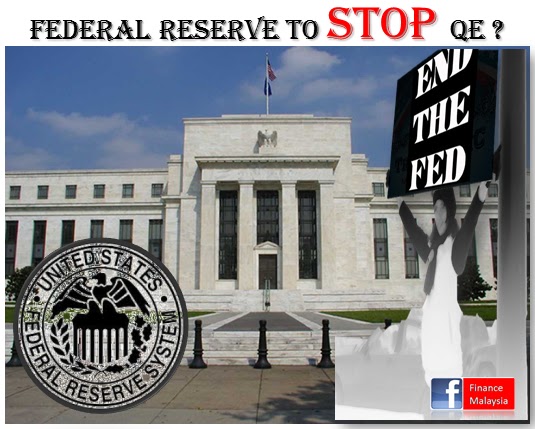
Global shares tumbles to multi-months low, especially in Asia whom did well year-to-date thanks to Japan's Abenomics. Commodities and gold also can't spare from the bearish sentiment across investment markets. Reason? US Federal Reserve may stop/scaling down their bond-purchase program. Huh!!! Is this the real reason? Like what I always said, analysts always give a reason for whatever bull or bear markets (after it had happen). For me, the main reason was (again) profit-taking activities took place in view of the good performances during first half of this year. How about Federal Reserve's QE ? It's funny to blame Federal Reserve for the corrections. First, why Fed want to stop QE at the first place? It's because US economy is recovering well. Wasn't this a good news to global markets? Definitely. Then, why we're so fear if Fed stop QE ? Doesn't make sense, right? Anyway, like what I said, the real reason was profit-taking activities which is normal af...

What's Wrong for an Economist to Predict the Upcoming Election?

Image
I am writing this post during midnight after I came across a report saying that Bank Islam chief economist suspended after predicting that opposition will win the upcoming election. As usual, Finance Malaysia would NOT include political elements in its blog post. And, we would like to stress here again, that we are discussing this topic WITHOUT any political elements. Then, what are we talking here? FREEDOM of VOICE & OPINION I knew that I could not sleep if I didn't speak up for En. Azrul Anwar. We are not here to defend anyone, neither to offend any parties. But, we should open up our mind, and accept other opinions with open heart. In this matter, the said bank is losing its credibility and reputation by suspending one of its key staff --- just because of his prediction. Why can't he speak freely? Will the bank lose its banking license because of this? Does he answer the question wrongly? NO... It's a prediction only, there is no right or wrong here. Everyone knew t...

Euro 2012 Football Championship: Poland's Economy Scores

Image
It's football season again. This round we have EURO 2012 Championship which will kick off on 8th June 2012. Are you ready? Before that, let us look at the championship from financial perspective. Don't care who will win the championship, Poland already emerged as the winner financially. Why? The UEFA European Football Championship has taken place every 4 years since 1960. For the first time in history, Poland and Ukraine have scored the chance to co-host the Euro 2012 Football Championship. Despite high set-up costs for the two emerging economies, both countries are likely to experience long-term economic benefits. The Statistic and Requirements: Estimated 670,000 football fans will pack into the new stadiums Around 1.5million spectators at fan zones  only Minimum requirement capacity of 30,000 to 50,000 spectators for infrastructure and modern stadiums Sufficient parking possibilities, hospitality facilities, luxury hotels and training facilities was needed Required transpor...

Europe’s Woes Flood Wall Street—But Not the Economy? (May 2012)

Image
After months of buildup, Europe’s sovereign-debt crisis has finally wreaked havoc on the U.S. stock market, as a wave of anxiety has prompted a major sell-off on Wall Street. We’ve seen a dramatically “risk off” environment with the Dow Jones Industrial Average dropping 3.52% — the biggest one-week decline since November — and the S&P 500 falling 4.3% . Among the hardest hit stocks were small caps and tech, with the Russell 2000 and the Nasdaq Composite falling 5.4% and 5.3%, respectively. To further underscore the risk-off environment, the yield on the 10-year Treasury still appears to be searching for a bottom, finishing at 1.702%, but falling below 1.700% intraday this week — a modern-era low. Spring Swoon? History may not be repeating itself, but it certainly is rhyming. Like the spring of 2010 and the spring of 2011, investors’ fears are coming to fruition and we are once again experiencing a “spring swoon.” Stocks a...

Summary of 2011 Bank Negara Malaysia Annual Report

Image
The global economy grew at a more moderate pace in 2011 after the strong rebound in 2010. The growth momentum was weighed down by continued structural weaknesses and fiscal issues in the advanced economies, geopolitical developments in the Middle East and North Africa region and the disruptive impact of natural disasters on global manufacturing production. These developments reverberated onto international financial markets and contributed to heightened market volatility throughout the year. Despite the less favourable external environment, emerging economies continued to record firm domestic-driven economic growth. At the same time, emerging economies faced increasing challenges from volatile capital flows and rising inflationary pressures. Amidst this environment, the Malaysian economy continued to grow steadily underpinned by the expansion in domestic activity and firm regional demand. The Malaysian Economy in 2011 The Malaysian economy recorded a steady pace of growth of 5.1% in ...

Annual Strategy 2012 by TA Securities

Image
2011 had triggered a wave of unwanted chain effects, which would not languish but resonate further into 1H12. While Japan is recovering from the worst ever tsunami and nuclear disaster, and oil prices stabilized after the unrest in the Middle East, conditions in Europe are expected to worsen before stabilizing. Global Economy – Risk Factors Extending into 2012 Positive news flows on drastic measures to restore confidence in Europe and maintain the credit ratings of core economies could boost market sentiment in early 1Q12 and push the index to test the all‐time high of 1,597. However, the reality check on the implication of European austerity measures and rising market risk premium due to the 13th General Election (GE) could push the index around 1,200 levels in 1H12 based on a minus two standard deviation from its last decade’s historical mean of 16.6x. A revival should ensue in the following months due to oversold conditions and anticipation of a subseque...

Key Highlights of BNM 3Q11 Report

Image
Titled as " ECONOMIC AND FINANCIAL DEVELOPMENTS IN MALAYSIA IN THE THIRD QUARTER OF 2011 ", Bank Negara Malaysia (BNM) review some interesting facts on the status of our economy and the market outlook going forward. The announcement was chaired by Central Bank's governor to address the media after the closing of Bursa Malaysia. Growth improved in the third quarter Despite the challenging environment, Malaysian economy registered a higher growth of 5.8% (2Q11: 4.3%), due to stronger domestic demand. The robust  domestic demand was driven by an  expansion in both household and business spending as well as higher public  sector expenditure.  Manufacturing sector  recording a significantly better performance supported by firm regional  demand for resource-based products, coupled with the normalisation in supply chain disruptions arising from the Japan natural disaster. The headline inflation rate , as measured by the change in the Consumer Price...

4 Components of Economic Growth (August 2011)

Image
So far, equity markets are down anywhere between 10-20% and bond yields in a number of major markets are reaching historic lows. Although it is difficult and nerve racking, investors should understand some of the forces behind what's creating this volatility and how they're likely to play out in the near term. When will market rebound? Again, we simply cannot answer that million-dollar question. If I know, I won't be writing this article here telling you all stories and facts. We should have a longer term view, especially during volatile times when fears dominating the marketplace. So, what are some of the driving forces behind? If we go back to basics, the 4 components that really drive economic growth are Government, Consumer, Corporate, Import & Export. If we look at each individually, we can do better opinion, by analyzing them. Government : Since 2008, governments have played an increasingly dominant role in the markets that we're familiar with. They are exp...