Posts

Showing posts with the label commodity

New Fund: OSK-UOB Capital Protected Essentials Fund

Image
As the world population continues its growth led by the emerging countries coupled with the higher purchasing power, the demand for the essentials or basic commodities (i.e. those that we use daily such as cotton for clothing, corn and sugar for food, crude oil for energy) have significantly increased. Further, with the imbalance of increase in demand and slower growth in supply, this has also resulted in a situation where consumers now and going forward have to pay more for fuel, clothing and food. With the expectation of further increase in the prices of these essentials or basic commodities, OSK-UOB has established a fund that will capitalize on the price movements of these essentials or basic commodities, which is OSK-UOB Capital Protected* Essentials Fund . Fund Asset Allocation: Indicative Asset Allocation Over The Counter (OTC) Option : A 4-year option whose underlying reference is a basket of 4 commodities, i.e. Brent Crude Oil, Cotton, Sugar and Corn, and each commodity is re...

Update: Gold Price Outlook (May 2013)

Image
Would you cut loss? Would you cost averaging? Or, would you accumulate at current level? These are a few questions from Gold investors since March 2013. What a difficult questions to answer... Here is our view on gold prices currently: Our answer is to cost averaging or accumulate now, and hold it at least until September 2013. Why? Let's read on... Lately, there is some good signs which favors gold prices in the short term: Federal Reserve chairman signaled records stimulus will continue until economy improves. Physical gold demand has surged after mid-April drops, especially from Asian consumers and central banks. US debt ceiling issue will be discussed again in September 2013, in which congressman will most likely to increase again, thus, printing more money. If you're a technical guy, then let's look at the chart above. A ' Double Bottom ' pattern was formed and gold prices may rebound very soon. It will be a gain of almost 8% if it surges towards 1,500 level....

Why GOLD is a different asset class?

Image
Today, gold is becoming an ever important asset class in the world. Banks nationwide is offering investors the opportunity to invest in gold, whether it is for capital preservation or capital gain. How well you diversify without investing in gold? This is the question being asked by those already investing in gold, and most of them already making profit out of it. But, is it really so different? Is it really a must have asset class? History of Gold Gold has been used for numerous monetary functions long long time ago, especially in China. Ancient people used gold as a form of currency and storage of wealth. By using gold as a medium to which paper currency was pegged, most modern international monetary systems were created since then. What drives up Gold price? The modern gold rush scenario happened since 2008 global financial crisis, driven by extremely low deposits rate on cash, very volatile equity markets and surging inflation . Negative real value of money is the key factor why m...

Oil & Gas: Why Malaysia is different? (21 Aug 2011)

Image
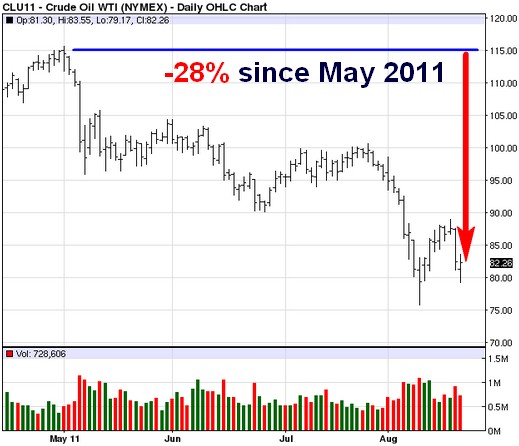
With oil prices hovering around USD80-85 per barrel currently, what is the outlook for Malaysia oil & gas (O&G) industry? Dubbed as " Black Gold ", crude oil is one of investors favorite asset classes, which is highly volatile.  Here, we examined the implications of lower oil prices, current scenario of the industry, and sustainability of oil price going forward. Feel free to share this out via our Facebook page ( www.facebook.com/financemalaysia ). What drags down oil prices? As most of you already know, US and Europe is main culprit for the sliding oil prices. High debt issues still lingering the global economy since 2008 global financial crisis. As such, the potential slowdown in the global economy as per investors perception, droves oil prices lower to current level. What is the implications? Actually, the correction of oil prices is driven by sentiment of traders, whom thinking that the demand is going ton be weak soon. What would you do if you're a CEO ...

US rating cut: Should we buy now? (9 Aug 2011)

Image
To answer that million dollar question, please let us examine the whole situation. First, what actually caused the market to slump? Second, the correction is short or long-term? In the end, it depends on how gut are you as an investor in this sentiment driven market. What actually caused the market to slump? Panic selling is my answer. Simple and straight to the point. Investors are so scared that they can't figure out what is going to happen after S&P downgraded US long-time AAA rating. This was the first time US was being downgraded. No previous record for investors to forecasts, so dump first la. Herd mentality is playing a very crucial role now (again). Short or Long-term correction? As mentioned, panic selling also means short-term correction . People are throwing their assets at a discounted price for the sake of getting their sleepless night away. After awhile, then only they realized that the actual situation is not as bad as they think. Then, investors will come back ...

Should we invest in Commodities or Resources? (July 2011)‏

Image
Unlike real estate, assets type such as commodities and resources investments tend to be highly volatile . This kind of assets classes is suitable for high risk takers. Knowing the characteristic of the assets classes is important to suit your investment objectives so that a correct investment decision was made. However, I noticed that many investors confused about Commodities and Resources, and they often lumped them as SAME . Is it true? Let's look at it separately (not together). Commodities vs Resources? Yes. Both is similar, yet there are some differences between them. First, let's talk about commodities. Commodities for me were comprised of metals such as copper, iron ore, silver, gold, platinum... Although many of us includes energy assets such as oil and gas into it, we can categorize it as an asset class which we can't consume with our mouth. Sometime, it was called hard commodities. Meanwhile, Resources are soft commodities. They comprises agricultu...

Government to increase electricity tariff? And, RON95 price? (24 May 2011)

Image
Before Government making the decision on two of the most important necessity of Rakyat, let us make a guess first. I know this would be a hot debate on whether Government should increase the electricity tariff and RON95 petrol price. Actually, both are linked closely with crude oil - the black GOLD. Electricity Tariff For TNB, the revise is crucial for its sustainably of the company to continue electrified Malaysia's economy. In fact, this is a long overdue issue, delay and postpone until now. But, why now? I believes that Government, initially wanted to review the tariff once the much anticipated general election. But, the Sarawak state election result could have derailed the early election plan. If we don't review now, TNB may facing financial difficulties which may impact the cash flow and credit ratings of its debts. High natural gas price is affecting the bottom line of the company. Petrol RON95 price Comparing to its brother (RON97), we should be more than happy to sti...

New Fund: OSK-UOB Multi-Asset Recovery Strategy Fund

Image
With the ongoing global economic recovery and the various opportunities created from the vast stimulus packages put forth by governments around the world, we are currently witnessing differing levels of economic expansion across all economies. And different asset classes such as equities, bonds, commodities, currencies and cash perform differently under different stages of economic expansion. Hence, OSK-UOB now offer investors a fund that will capitalize on the potential opportunities arising from the different market conditions resulting from this economic expansion phase by dynamically investing in multi-asset classes that are expected to do well in specific market conditions. The OSK-UOB Multi-Asset Recovery Strategy Fund is a fund-of-funds which aims to achieve long term capital appreciation by investing in a portfolio of exchange traded funds (ETFs). The fund aims to achieve its objective through a portfolio of ETFs chosen from 5 major asset classes , i.e equities, bonds, commod...

New Fund: RHB Dynamic Oil-Gold Capital Protected Fund

Image
Launched on 11th March 2011, RHB Dynamic Oil-Gold Capital Protected fund is investing in oil and gold, which have the potential to perform in both areas that have great bullish and bearish markets. This is a 3 years capital protected fund . As usual, it will invests at least 85% of the NAV in zero-coupon negotiable instruments of deposits. Meanwhile, up to 10% of the fund's NAV will invest in an over-the-counter (OTC) option that gave investors returns (if any). The OTC option will provide exposure to the performance of the Option Strategy, which is an index, maintained by the issuer of the OTC option and is subject to a dynamic risk adjustment linked to the realized volatility of the underlying. Option Strategy This Option Strategy is a rules-based strategy computed and developed by the option issuer / counterparty. It aims to tap into the growth of oil and gold through the use of a " momentum " based strategy to capture the trends of the Underlying and also, volatilit...

How far could Oil price RISES?

Image
As usual, another episodes of tension in the Middle East pushes global oil prices higher, and surpassing $100 per barrel this time. We did seen this kind of scenario before in the Middle East during 1973-74, 1979, and the Iraq war in 1990. Are there any different this time? Libyan leader Muammar Qaddafi By Credit Suisse ,  We believe the rise in oil prices is manageable . Each 10% rise in oil prices only takes about 0.1% off global GDP and 0.2% off US growth. With Western wage growth muted, central banks are unlikely to raise rates on account of oil alone. Our analysts see oil prices below $100 pb this year, supported by the following reason which differs from previous oil crisis:- There is enough spare capacity in the global oil market to deal with supply-side disruptions as long as they are not too extreme The energy intensity of global GDP has fallen by around 40% over the past 40 years There is unlikely to be the same inflationary follow-through as in the 1970s Oil producer...

Global Food Crisis, a Repeat of 2008?

Image
KLCI is grappling up for a successful 4 days in a row this week, and perhaps today is the 5th day of record breaking level. However, I am concerned about the health and the sustainability of the market, after reading a report by Food and Agriculture Organization of the United Nations (FAO). And, one of the popular Mandarin Dailies highlighted the potential food crisis as its main topic today. Finance Malaysia did some analysis, and would like to comment on the issue which could be a hot topic for many nations very soon, including Malaysia. In fact, international prices of most agricultural commodities have increased in recent months, some sharply. This has led to a level near to its peak in June 2008. What causing the prices to increased? worsening outlook for crops in key producing countries, which require large draw downs of stocks and result in tighter global supply and demand balances of course, weakening USD, which continues to sustain the prices of nearly all commodities continuo...

Top 3 Commodity Picks for 2011

Image
Forget about supply and demand issue of commodity, everyone knows the main mover now is Emerging Market, especially China. As long as US economy not yet recovered, China was expected to continue its great appetite to consume commodities globally. Not for its consumptions, but mainly because of China's currency management. China, already the largest creditor of US by holding USD which was slipping with a series of quantitative easing programs, would definitely forced China to diversify its holding elsewhere. However, China would hand-picking according to its own local demand. As such, Finance Malaysia forecasts those commodities which were used heavily in construction , infrastructure , production will continue to perform in 2011.   Top pick #1: Palladium One in four goods manufactured today either contain platinum group metals or the platinum group metals play a major role during their manufacturing process. Palladium was used in many electronics including computers, mobile phones,...

When would asset bubbles in Emerging Market "Burst"?

Image
Do you discounted the possibilities of asset bubbles in Emerging Market ? Even though our governments, including China, saying that asset bubbles is under-controlled for almost one year now, yet, investors are not comfortable with the record breaking prices. Investors are encountering high prices in properties, commodities, resources, and of course, shares market in emerging markets. People are investing, buying, spending, and borrowing to an extent that would caused asset bubbles in various sectors. Return , the only thing in mind...   Meanwhile, investors are chasing for returns to beat the market at large, and to avoid being left behind. This " Kiasu " behavior are only pouring oils on fire. Yet, returns is the only thing in mind, and those "kiasu" investors are winning the game to date. For those who does not participate in the game were blaming them for causing the high property prices, undermining their affordability to own a house.   When did the...

Why China raise interest rate? And, what's the effect?

Image
Yesterday, China surprisingly raised its interest rate by 0.25%  as follows: - 1 year lending rate from 5.31% to 5.56% - 1 year deposit rate from 2.25% to 2.50% Why China raise interest rate? 1. To cool down the over-heating property sector. 2. Combat inflation 3. Low liquidity in the banking system While inflation was hovering around 3.5% currently, even though the deposit rate has been raised, the net real interest rate is still in negative territory (3.5% - 2.5% = -1.0%). This is one of the main reason why Chinese were going all out to invests, especially in real-estate, due to its low yield if sitting in the bank (even lower than Malaysia). However, China would be facing another problem... Raising interest rate would attract capital inflows , which could dampen the purpose of containing inflation. Foreign investors view Chinese renmimbi as undervalue , mainly due to interventions by Chinese government. The latest news could ignite a fresh round of thoughts,...

New Fund: AmCommodities Equity Fund

Image
AmMutual sees potential investing in one of the hottest asset classes nowadays - Commodities. Fundamental characteristic investing in commodity: Commodities outperformed other asset class Low correlation with traditional asset class Commodities are usually used as an inflation hedge Evergreen theme = Increasing Demand vs Diminishing Supply Category          : Feeder Fund (Global equity) Offering period : 19 July - 8 August 2010 Min investment : Rm1,000 Min top-up       : Rm 500 Sales charge     : 5%