Posts

Bangladesh’s Garment Industry
Image
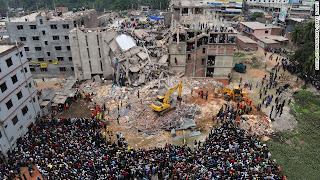
Globalization created the opportunity to capitalize on cheap labor in developing countries. Although China remains the primary source of apparel manufacturing for many developed nations, the country’s demand for increasing wages has lead to the search for new labor markets. A new sources of cheap labor is Bangladesh—one of the poorest countries in the world, located in South Asia. Bangladesh has a population of approximately 160 million, and remains plagued by corruption, massive poverty and political instability. A Deathly Shortcoming: The cheap labor in Bangladesh has made it the second biggest apparel exporter—an industry worth $19 billion. The wages for the workers in Bangladesh are a meager $0. 18-$0.26 an hour, while China’s workers average $1.34 an hour. This motivated many manufacturers, like Wal-Mart and Sears to shift its production to the country, allowing them to squeeze out a slightly higher margin. However, the working conditions for Bangladeshi workers include an a...

This Is As Good As It Gets

The GDP announcement this morning for the first quarter of 2013 was 2.5 percent, well below the 3 plus estimates that economists were expecting.    This will not be the first disappointment.  Folks like Jim Cramer on CNBC can't understand why businessmen are reluctant to expand capital equipment and hire employees.  That's because Cramer is a media celebrity not a businessman. If Cramer were even remotely aware of the actual business climate that ordinary folks have to contend with, he would know what the problem is -- over regulation, absurd tax levels, Obamacare, EPA regulations, Dodd-Frank.  It is almost as if the Obama Administration has declared war on the US economy.  Anything that smacks of business success is viewed suspiciously by the Administration (and by Jim Cramer, I might note). The talking heads can't figure it out, but the economics are simple.  If hiring an employee at a $ 35,000 salary means it costs you $ 75,000 per year, you ar...

Ignorance and the NY Times

Eduardo Porter, an "economics" columnist with the NY Times, has penned an article this morning in the NY Times that purports to address the lack of solutions to today's economic stagnation.  Porter reports on a recent IMF sponsored conference of economists that was supposed to address problems posed by the "financial crisis of 2008." According to Porter, the 2008 collapse discredited policies of lower taxes and de-regulation.  You have to wonder what world Porter lives in.  Was Sarbanes-Oxley an example of the deregulation?  Were the Congressionally-imposed strengthening and rule-making for Fannie and Freddie examples of de-regulation?  Exactly what is Porter referring to?  Or do facts matter anymore when you have a convenient agenda ready? Here is an example of the absurd conclusions that Porter draws in his article: "One lesson from the crisis -- first learned in the 1930s and corroborated in several contemporary analyses -- is that when interest rates lo...

How to get your PRS Tax Relief statement from PPA ? (April 2013)

Image
In conjunction with the NEW tax relief available from YA2012, many Private Retirement Scheme (PRS) contributors are wondering how can they get the tax statement for income tax filling. To address your concern, here you go... (If you don't know what are we talking about, please find out " What is Private Retirement Scheme? ") To recap, contributions into a PRS scheme can enjoy a tax relief of up to RM3,000 from YA2012 - YA2021. If you did contribute some money into a PRS scheme in 2012, congratulations, you're entitled for PRS tax relief for YA2012. If you haven't, no worry, you still got time to start contributing before end of this year. Back to the topic, please follow these few easy steps to get it: Please surf www.ppa.my and click log in. I believe you already get your PIN from PPA when you made your first contribution. If not, please contact PPA and request again. After log in, you will arrive at the following page. Supposedly, you can download the tax reli...

Personal Income Tax for YA2012

Image
Finance Malaysia hopes this article doesn't come late to give you some info on Personal Income Tax filling for year of assessment 2012. Maybe due to the general election, which had diverts our attention lately. Lol. Anyway, do remember to file your income tax before 30th April oh!!! Well, here is the list of Personal Tax Relief for YA2012. And, I would like to highlight to you, in RED color words , some changes/differences from previous year. Personal Tax Relief for YA2012 Item No.11: This would replace Item 10 from YA2012-YA2017 with higher amount of RM6,000 Item No.23: Private Retirement Scheme (PRS) is the NEW item which can help you reduce tax further with additional RM3,000 tax relief from YA2012-YA2021. As such, Item No.22 would be replaced until after YA2021. All other items remained the same. Do reduce your tax payable by maximizing the tax relief amount. Remember to keep a record and file it properly. Happy tax filling. Thanks. Blue color: Tax relief that we can adjust e...

Even the WSJournal Doesn't Get It

David Wessel has a lengthy article in this morning's Wall Street Journal about the future direction of the world's economies.  He begins with Europe and then walks the reader through the US, Japan, China, and the rest of the world.  In every case, Wessel's discussion is about government policy. The overall theme is that economic recovery depends upon government policy, discretionary policy at that.  He discusses the twists and turns of policymakers as they, according to his story line, attempt to guide their economies to the promised land. But, that is exactly the problem.  Once government policy becomes the determinant of the economy's future, the economy no longer has a future.  The proper role of government in a free market is to lay down the rules of the road and then to get out of the way.  Increasingly, a government of rules is not to be found. Instead we watch daily as policy makers, who frequently have a very limited knowledge of economics, move thi...

Taming the Beast

When an economy collapses, usually with the financial sector leading the way, everyone fears that it will not soon recover.  But, history tells us otherwise.  The numerous financial and economic collapses from the end of the civil war in the US up to the start of World War I took place during the fastest spurt of economic growth in US history.  The US economy had no central bank during this period and the government was so tiny that fiscal policy was largely non-existent.  Absent modern policy tools, what happened? What happens, when government is not around to step in, is that economies recover on their own.  That's what the period from 1865 to 1914 teaches us.  It was during that period that the US overtook other economic power houses to become, by the end of the first World War, the most powerful economic engine in the world.  That is the outcome one can expect if the central bank is non-existent and if government fiscal policy is non-existent. But ...