Posts

College Grads and Jobs

There is a growing discussion about whether or not college graduates are generally prepared for the workforce.  This is a very interesting (and revealing) discussion. This is not so much about GPA as it is about more fundamental problems -- attitude tops the list.  Far too many college graduates think that they have 'paid their dues' by attending college and collecting a degree.  Many seem to think that joining the work force is akin to joining a fraternity or sorority.  They seem disappointed that employers' have high work expectations and are in no hurry to provide massive benefits and a club-med work environment to a rookie employee. What every employer wants is someone committed to work hard, to learn new skills, and to already possess basic writing and mathematics skills.  The vast majority of college graduates, measured against these expectations of business do not measure up.  That's the sad truth about higher education.  We don't insist that ou...
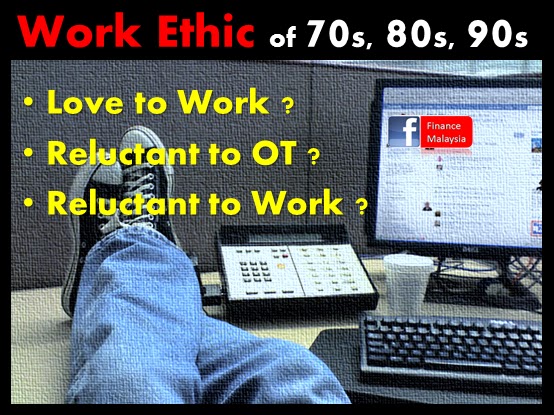
Work Ethic of 70s, 80s, 90s

Image
Different generations have their own view on working. You like it or not, working is part of our live. No work = No life. However, this equation has since changed to " Working = No life ". Do you agree? Generally, those born in 70s were perceived to be loving their job. They work hard mainly because of 3 meals/day. For them, a secured life means having a stable job with stable income. They believe that with every efforts you put in, that will reward you back later. As such, over time (OT) is nothing for them. As a responsible 70s, losing their job is a serious matter they tend to avoid. That's why they usually found another job first, before resigning. How about 80s? Other than chasing for stable income, those 80s working adults will also look into the job scope , opportunity for promotion , or working environment . They will take initiative to find for better job. Hence, job hopping is very common for them. Notably, 80s are reluctant to sacrifice their quality of life b...

How Much You Need To Save If You Ever Want To See Your Kids Graduate?

Image
In an age where the common degree has become a pre-requisite and not so much an advantage, ensuring that you have enough to see your children through a reputable university has inadvertently become one of the most important responsibilities you’ll face as a parent. Unfortunately, knowing how much to save for your kids’ tertiary education is not an easy question to answer.  In fact, it is downright complex in view of the vast differences in costs from degree to degree, university to university, and country to country.  And even for those who do have a number in mind, there is still the question of when you should start saving , using which savings / investment vehicle. If you have been wondering about your financial capabilities to finance your kids’ tertiary education, or you have been seeking a workable method to save a sizable study fund for your children; allow iMoney to shed some light on this matter with their latest infographic: Courtesy of iMoney.my

Lesser Amount can be Withdrawn for EPF Members Investment Scheme effective January 2014

Image
Are you an EPF member who withdraw money out for investment scheme? Then, this is a very important news to you. Effective January 2014, the minimum basic savings required in Account 1 was revised upward. This will affect all of YOU who withdrawn certain amount from EPF account 1 for eligible investment purpose. Higher limit means lesser money you can withdraw from EPF in the future. How much will be increased? Based on the chart below, the percentage increased can be as high as 64%. Generally, the increasing amount was at least 50% once you're age 27 onward. How to calculate how much can I withdrawn from EPF account 1? What's the different or impact? Depending on your age and how much savings in account 1, the impact varies by members. For better explanation, please see example below: Finance Malaysia hopes this post can enlighten you on EPF members investment scheme withdrawal. You may share this to your friends. Thanks.

The Nasdaq Flap

The Nasdaq halted trading today and was down for a couple of hours.  Listening to the financial media (CNBC, Larry Kudlow, etc.), you would have thought a great crime had occurred.  99 percent of the investing public had no idea and could care less, me included. What serious investor could possibly be harmed by a two hour shutdown of the Nasdaq?  Are these pundits serious?  If there was ever an 'inside baseball' issue, this is it.  Only manic traders and hedge funds could possibly care one way or another about the Nasdaq shutdown. No portfolio of any serious investor could possibly be damaged by a temporary shutdown of a stock exchange.  This is a ridiculous tempest in a teapot.

Obama and Higher Education

Just what we need, the Obama tenacles reaching into higher education.  In typical style, Obama points to a problem -- the high cost of higher education -- and proposes a solution that has nothing to do with the problem and actually will likely make the problem far, far worse than it is now.  This has been the pattern with the economic rescue plan, with the 'affordable' health care act, with wind and solar initiatives, and on and on.  Every problem that Obama has inherited has become a much bigger problem under his leadership. What is wrong with higher education?  Mainly the government, as in most other things.  Federal funding for research grants and student loans has made higher ed less interested in scholarly pursuits and more interested in the pursuit of federal largesse.  Students are borrowing huge amounts of money to maintain a college lifestyle that for prior generations was simply unavailable.  Who could spend that kind of money on beer and fit...

Media Misleads Once Again

Reuters has a story today about the jobless claims number that is completely absurd.  According to Reuters, "...then new claims... rose...but...gave a positive signal for hiring during the month."  This conclusion is based upon absolutely nothing.  What the data, in fact, shows is that jobless claims rose last week and rose more than the market expected -- not good news at all.  Worse, the numbers are barely (five percent on average) lower than the numbers in the early part of the year.  Given that revisions are typically well above five percent, a drop of five percent is statistically irrelevant. The real truth is that the economy is not producing enough jobs and the few that are produced are mostly part-time, low wage jobs.  Not surprising, given the Obama economic program, which guarantees economic stagnation as far as the eye can see. The media has made a habit of consistently distorting the truth about the American economy in their cheerleading effort ...